
From Static Checklists to Systems: Rethinking Closeout Workflows
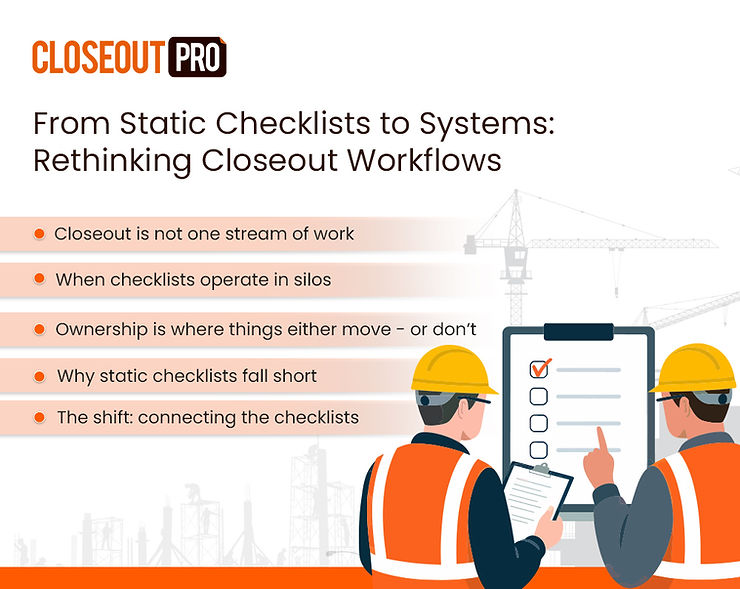
Checklists are a core part of how we as construction teams operate. They bring structure. They define what needs to get done, and in closeout, they’re an integral part of getting to the finish line.
This isn’t about replacing checklists. But as projects get more complex - especially toward the end - the challenge isn’t whether you have a checklist. It’s how that checklist actually works in practice.
Closeout is not one stream of work
We often talk about closeout as a phase. But when you’re actually in it, that’s not what it feels like. It’s multiple things happening at the same time:
Financial closure
Deficiency resolution
Documentation and handover
Inspections and approvals
Demobilization
Each of these has its own checklist. Different teams. Different owners. Individually, they make sense but they don’t move independently - and that’s where things start to break down.
When checklists operate in silos
On most projects, you’ll see multiple parallel trackers:
Punch lists
Subcontractor closeout logs
Financial closeout sheets
Turnover checklists
Everyone is working their list. But no one is really seeing how it all connects. In reality, these workflows are tightly linked.
An open deficiency delays inspection sign-off.
Inspection sign-off delays final billing.
Final billing impacts subcontractor closeout.
This happens all the time. But when everything sits in separate checklists, you just don’t see it clearly. So teams end up managing pieces of closeout - without really managing closeout.
Why static checklists fall short
Most checklists tell you two things:
What’s done.
What’s not done.
But at this stage of the project, that’s not enough. What you actually need to know is:
Who owns this?
What’s blocking it?
What does this depend on?
Does this even matter right now?
Without that, the conversation becomes reactive:
“Is this done?”
“Can you send this?”
And you see it on every project. Lots of movement. Lots of emails. But not always real progress.
Ownership is where things either move - or don’t
You can have the best checklist in the world - but if ownership isn’t clear, things stall.
Not because people aren’t trying - but because:
Responsibility is spread out
Expectations aren’t aligned early
Subcontractors get pulled in too late
So the teams ends up chasing. Once ownership is clear at the right level, things move very differently.
The shift: connecting the checklists
The next step isn’t adding more checklists. Most teams already have enough of those.
The shift is connecting them. When you start looking at closeout as a system - not separate lists - you begin to see:
What’s actually blocking progress
How workflows affect each other
What needs attention now
Whether you’re actually getting closer to closing
That’s a very different level of control.
Final thought
A checklist answers:
“Is this item complete?”
But closeout is really about:
“Are we actually ready to close?”
Because you can have everything looking close - and still not be able to close. Checklists are the foundation. But when they are siloed and static, they can only take you so far.
Closeout is about coordinating multiple teams, workflows, and responsibilities toward one outcome:
A project that is fully closed - financially, operationally, and contractually.
Where this is heading
More teams are starting to rethink this - not by adding more lists, but by connecting and defining clear ownership.
Because once ownership, and workflows are visible in one place, closeout becomes far more predictable. That’s exactly the problem we’ve been focused on with Closeout Pro - building around planner to bring structure and control to how closeout actually gets executed.